
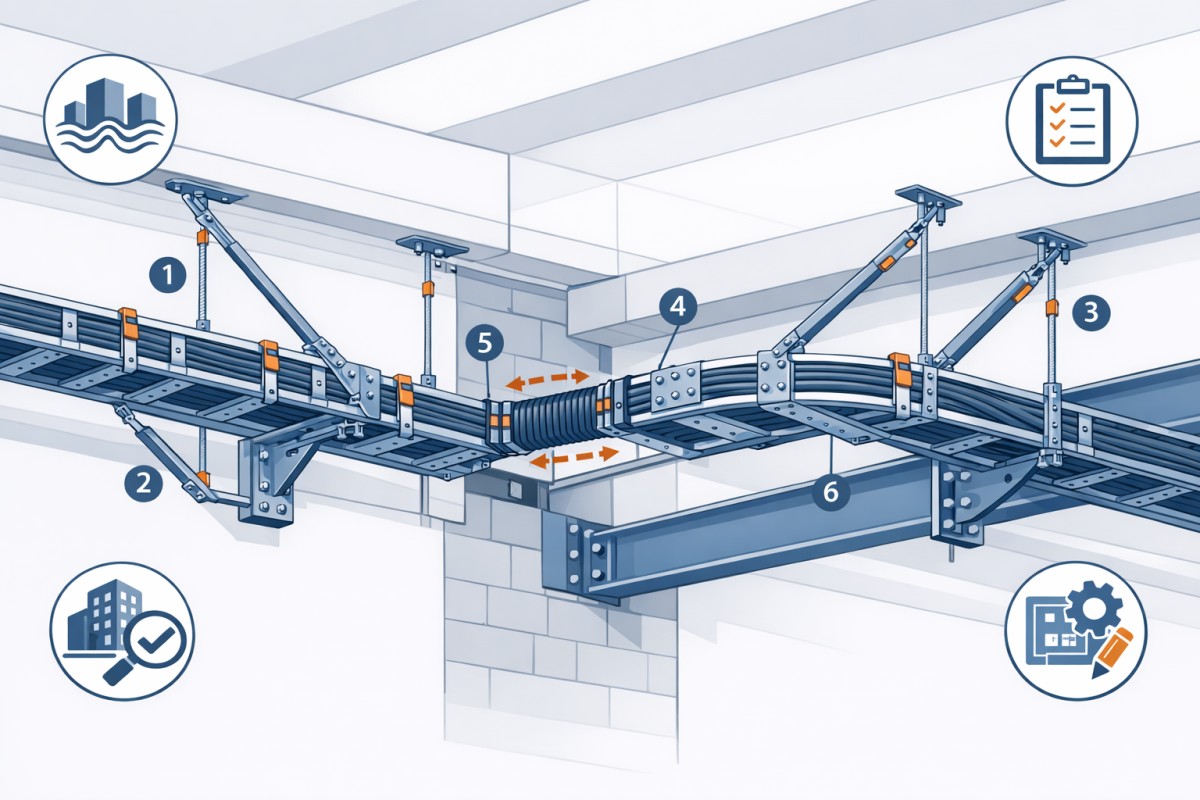
Figure 1. Technical overview of seismic cable tray design considerations including bracing splice reinforcement movement accommodation cable retention and support verification.
High-seismicity projects place much greater demands on cable tray systems than ordinary installations. During an earthquake, cable trays are exposed not only to gravity loads and normal service loads, but also to lateral movement, vertical acceleration, vibration, and building drift. If these demands are not addressed during design, cable trays can become one of the most vulnerable nonstructural systems in a facility.
The consequences are not limited to tray damage. Failed supports, separated splice joints, displaced cables, and damaged penetrations can interrupt critical power, control, data, or life-safety systems when they are needed most.
This checklist focuses on the engineering decisions that matter most when specifying cable trays for high-seismicity projects.
1. Confirm the Governing Seismic Design Basis
Before selecting tray hardware, confirm the seismic design basis for the project. In practical terms, the cable tray design team needs the project-specific seismic criteria, not just a vague statement that the building is in a seismic area.
At a minimum, the cable tray designer should confirm:
- the applicable code basis
- the project seismic design category or equivalent seismic classification
- the design spectral values or equivalent seismic demand parameters
- the component importance level for the supported electrical systems
- the tray support elevations and attachment conditions
These inputs affect tray selection, brace layout, splice design, anchor demand, and cable retention strategy.
2. Select a Tray Type That Matches Seismic Demands
Cable tray type matters in seismic design because stiffness, mass, joint behavior, and cable containment all affect performance.
In many high-seismicity applications, ladder tray is often preferred for primary distribution because it provides a strong structural form with relatively efficient weight-to-strength performance. Perforated or trough trays may still be appropriate, but they should be evaluated carefully for mass, support spacing, and cable retention. Wire mesh or basket systems can be suitable in some installations, but their splice and support details need especially careful review when significant seismic movement is expected. Channel trays are generally better reserved for light-duty runs rather than major seismic distribution routes.
The right tray type should be selected based on the expected cable load, support spacing, bracing method, and required retention performance—not on ordinary installation habit alone.
3. Engineer the Bracing and Attachment System
In seismic design, the support and bracing system is often more critical than the tray section itself.
A standard gravity-only support layout is not enough for a high-seismicity installation. The system should be designed to resist lateral forces, longitudinal forces, and uplift where required. Manufacturer installation guidance and project engineering calculations should govern brace spacing, brace orientation, support attachment, and connection detailing.
For practical specification, that means:
- do not rely on gravity-seated tray supports alone
- require positive attachment where uplift or horizontal displacement is possible
- coordinate brace layout with the structural engineer and tray manufacturer
- verify that the brace system is based on tested or engineered details, not just field preference
In high-seismicity projects, support and bracing details should never be treated as optional accessories.
4. Specify Seismic-Rated Splice Joints
Splice joints are one of the most common weak points in seismic tray systems. Under repeated or cyclic movement, ordinary splice details may loosen, deform, or separate even when the tray side rails themselves remain intact.
For high-seismicity projects, specify splice assemblies that are appropriate for the expected seismic demand. If the supplier offers seismic certification or shake-table test data for the tray assembly, request it and verify that the tested configuration actually matches the intended installation.
Splice strength should be reviewed as part of the full seismic load path, not as a minor connection detail.
5. Address Differential Movement and Seismic Joints
Even a well-braced tray can fail if it crosses parts of a structure that move differently during an earthquake.
Cable trays that cross building seismic joints, connect separate structures, or pass between rigid and more flexible support zones need a deliberate differential-movement strategy. This may include flexible connectors, movement allowances, or specially detailed transitions at seismic joints and equipment interfaces.
Differential movement should always be treated as a separate design issue from ordinary component strength.
6. Provide Cable Retention, Not Just Cable Support
In open tray systems, seismic performance is not only about keeping the tray attached. It is also about keeping the cables where they are supposed to be.
Depending on the installation, that may require:
- cable retention straps
- covers or hold-down accessories
- special retention hardware at changes in direction
- additional review for emergency and life-safety circuits
Retention hardware should be selected as part of the seismic system, not added later as an afterthought.
7. Verify Anchors and Building Attachments
The seismic performance of a cable tray system depends just as much on the building connection as on the tray itself.
Every hanger, trapeze, beam clamp, concrete insert, and post-installed anchor should be reviewed for the seismic forces expected at that attachment point. Where concrete anchorage is involved, the engineer should verify that the selected anchor type is appropriate for the substrate and for seismic demand, especially where cracked concrete conditions may apply.
In specification terms, do not assume that hardware acceptable for gravity support is automatically acceptable for seismic support.
8. Require Documentation and Final Verification
A seismic tray system should not be treated as good enough just because the parts arrived on site.
For higher-seismicity projects, require:
- engineered or manufacturer-approved seismic support details
- tray and splice product data
- anchor and attachment data
- seismic calculation packages where required
- installation drawings showing brace locations and details
- post-installation inspection confirming the as-built system matches the design intent
Field changes are common on electrical projects, and seismic performance is often compromised not by the original design, but by undocumented installation changes made during coordination.
Final Checklist Before Approval
Before signing off on a cable tray installation in a high-seismicity project, confirm that:
- the seismic design basis is clearly identified
- the selected tray type is appropriate for the cable load and seismic demand
- supports are positively attached and properly braced
- splice joints are suitable for seismic service
- differential movement has been addressed where required
- cable retention measures are included where needed
- anchors and building attachments have been verified
- the installed system matches the approved details
A cable tray system that passes these checks is far more likely to remain functional and contained during a major seismic event. A system that fails them may still look acceptable in normal service right up until the earthquake occurs.
Conclusion
The most important lesson for seismic cable tray design is simple: do not treat seismic performance as an accessory. It is a core design requirement for nonstructural electrical systems in high-seismicity projects.
The best outcomes come from combining the right tray type, the right bracing and attachment details, the right movement allowances, and the right documentation. When those elements are coordinated early, cable tray systems can perform far more reliably under earthquake demands.
Planning a project in a high-seismicity region? Contact our team for support with tray selection, seismic bracing details, and project-specific compliance documentation.
Navigation
Send Us A Message
Get in touch with us
Phone