
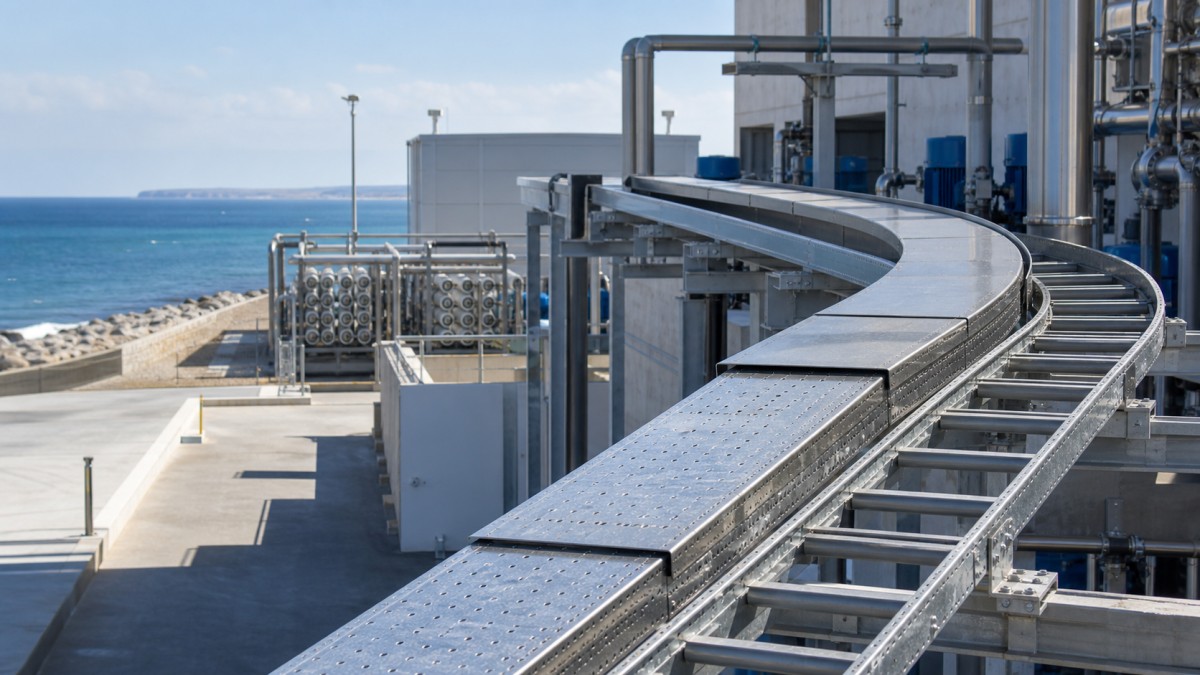
A seawater desalination facility combines marine exposure with process equipment, high-pressure pumping, chemical dosing, electrical rooms, pipe racks, laboratories, and continuous maintenance operations. Cable tray routes may pass beside intake structures, membrane systems, utility buildings, chemical areas, and outdoor equipment. Each zone can place different demands on the tray finish, covers, supports, and access strategy.
For buyers, the main risk is treating a desalination project as an ordinary indoor water treatment job. The coastal atmosphere, washdown activity, salt deposits, and chemical exposure should be mapped before the tray schedule is issued. A complete procurement package should also cover fittings and supports, because these components experience the same environment as the tray body.
Map the Desalination Plant by Service Environment
The tray material should follow the actual route conditions. An enclosed control room may need a clean and accessible perforated tray, while an outdoor pipe rack near the seawater intake may need stronger corrosion protection and selected covers. Chemical dosing and cleaning areas may require a project-approved corrosion-resistant material or a coating system that can be maintained correctly.
Start the design review with a route register. For each route, record the location, cable group, exposure, support substrate, approximate load, and inspection requirement. This gives the EPC team a common basis for choosing tray types and prevents the RFQ from reducing a complex plant to a single line item called galvanized cable tray.
- Seawater intake and outfall zones may have salt spray, humidity, and exposed steel supports.
- Reverse-osmosis process areas need clear access around pumps, membrane skids, valves, and instruments.
- Chemical dosing areas require review of nearby vapors, cleaning routines, and material compatibility.
- Electrical rooms need cable separation, bending space, maintenance access, and clear identification.
- Onshore utility and administration areas may use a different finish from the process and intake zones.
Choose Tray Types by Cable Function
Ladder Tray for Pumping and Main Power Routes
Ladder cable tray is a practical option for larger power cables, motor feeders, and longer process routes where ventilation and cable pulling access matter. The rungs provide regular support, but the selected spacing and side-rail height should match the cable diameter and the required fixing method. Heavy routes should be checked against the manufacturer's load information and the proposed support spacing.
Perforated Tray for Controls and Smaller Services
Perforated cable tray provides more continuous bottom support for control, instrumentation, lighting, and auxiliary cables. The hole pattern can make fixing and branch connections convenient, but the buyer should confirm that the holes, side rails, and fittings are suitable for the specified cable clamps and dividers. Where frequent access is expected, an open tray may be easier to inspect than a fully enclosed system.
Covers and Trunking for Selected Protection
Covers can help reduce direct deposits, accidental contact, and exposure in vulnerable outdoor or process locations. They should be specified only after checking heat dissipation, drainage, condensation, inspection access, and the need to add cables later. Cable trunking or trough-style tray can be useful for clean protected branches, wall-mounted routes, and areas where the appearance and enclosure of smaller cable groups matter.
Material Finish, Drainage, and Fittings
Hot-dip galvanized steel is often reviewed for outdoor plant routes because it offers a practical balance of mechanical strength and corrosion protection. However, the procurement document should state the required process and finish rather than rely on a generic label. Confirm the tray body, covers, supports, splice plates, bolts, nuts, and washers are compatible with the intended environment.
Stainless steel may be appropriate for especially aggressive or frequently washed areas when the project specification allows it. The grade and fastener selection should be reviewed together with fabrication, edge condition, and cleaning requirements. Powder-coated products may suit controlled indoor spaces or visual identification, but the buyer should verify pretreatment, coating durability, and whether field damage can be repaired.
Drainage is another practical point. Outdoor trays and covers should not create pockets where water or cleaning liquid remains trapped. Route slopes, drain openings where appropriate, cover details, and the connection between horizontal and vertical sections should be coordinated with the structural and process layout.
| Plant zone | Typical tray direction | Key review points |
|---|---|---|
| Intake and coastal outdoor route | Marine-finish ladder or perforated tray | Salt exposure, drainage, covers, support corrosion |
| RO process and pump area | Ladder tray for power, perforated tray for controls | Cable pulling, vibration, access, route congestion |
| Chemical dosing or cleaning area | Covered or corrosion-resistant system as specified | Chemical exposure, washdown, material compatibility |
| Indoor control and electrical rooms | Perforated tray or compact trunking | Segregation, access, spare capacity, clean layout |
Support Design and Maintenance Access
Desalination plants are crowded with pipes, pumps, valves, steelwork, and access platforms. Cable tray should be coordinated early so supports do not block maintenance paths or clash with process equipment. The RFQ should show whether the supplier is responsible for cantilever brackets, trapeze supports, vertical supports, hold-down clamps, and connection hardware.
Support spacing should be checked against the expected cable load, tray configuration, span, fittings, and the most demanding section of the route. Bends, tees, reducers, vertical changes, and transitions may require additional support. A straight-length price without a fitting and support schedule can make the initial quotation look attractive while leaving the installed cost uncertain.
Keep covers removable and leave enough working space for cable inspection. Where new pumps, instruments, or control panels may be added, reserve route capacity and identify accessible branch points. A neat route is valuable, but maintainability is more important than forcing every cable into the smallest possible tray.
Installation, Cleaning, and Handover Checks
Desalination projects benefit from an installation checklist that is tied to the plant zones. The site team should verify tray alignment, support tightness, cover fit, drain paths, fitting orientation, and the clearance around pumps, valves, instruments, and access walkways. Where a route passes from an outdoor zone into an electrical room, the transition should be checked for water entry, sharp edges, and cable bend requirements.
Cleaning and maintenance teams should also be able to remove covers without disturbing adjacent services. During handover, record the installed tray type, finish, route area, spare fittings, and any approved field repairs. This information is useful when the plant owner later extends a pump line, adds an instrument, or replaces a cable route in a corrosive area.
Where the plant uses different finishes, mark the zone boundaries on the drawings and packing lists. This prevents a replacement section intended for an indoor room from being installed on an exposed seawater route.
RFQ Checklist for Desalination Cable Tray
- Divide the plant into indoor, outdoor coastal, intake, process, chemical, and utility service areas.
- State the tray type, width, height, thickness, finish, cover requirement, and straight-length unit.
- Include elbows, tees, crosses, risers, reducers, splice plates, dividers, covers, clamps, and supports.
- Confirm drainage, field cutting, coating repair, cleaning exposure, and the treatment of exposed edges.
- Request dimensional drawings, material or coating documentation, loading information, and packing details.
- Check that the complete system matches cable glands, equipment entries, support steel, bonding details, and access platforms.
For overseas procurement, a route schedule and marked-up layout are the best starting point. HONGFENG / Cable Tray Pro can help buyers compare ladder tray, perforated tray, trunking, stainless or galvanized options, and the accessories needed for a complete desalination plant route. Share the environmental zones, cable list, quantities, and drawings for a practical quotation review.
Navigation
Send Us A Message
Get in touch with us
Phone