
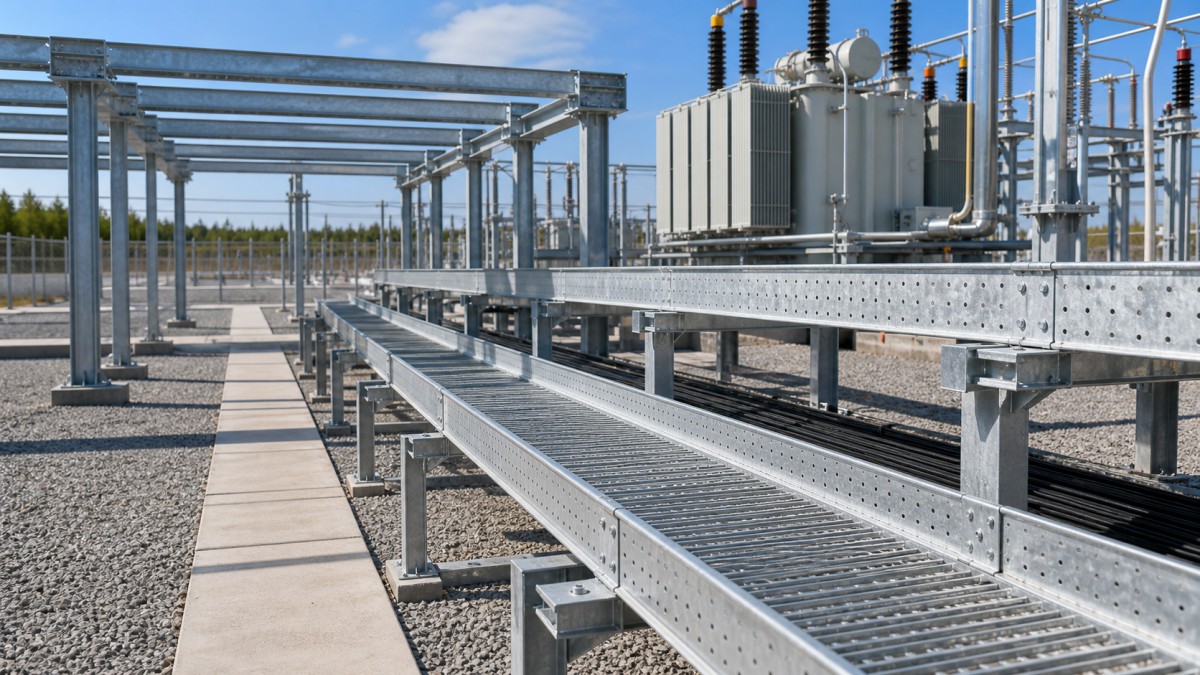
Outdoor electrical substations are not ordinary cable tray environments. Cable routes may connect control buildings, transformers, switchgear, protection panels, metering cabinets, communication equipment, battery rooms, cable trenches, and outdoor equipment structures. Many of these routes are exposed to sun, rain, dust, wind, condensation, temperature change, and maintenance activity for many years after installation.
For buyers, the main challenge is that a substation cable tray package is rarely just a set of straight tray lengths. It is a routed support system. The final order may need ladder cable tray, perforated cable tray, covers, bends, reducers, tees, splice plates, hold-down clamps, support brackets, fasteners, grounding accessories, identification labels, and packing by installation area. If these items are not specified clearly at the RFQ stage, the site team may face missing accessories, field drilling, incompatible finishes, or delayed cable pulling.
This guide explains how procurement teams, EPC contractors, electrical distributors, and project engineers can specify cable tray systems for outdoor substations with fewer surprises.
Why Substation Cable Tray Needs Early Coordination
Substation cable tray routes usually serve several cable groups at the same time. Power, control, protection, instrumentation, communication, and auxiliary circuits may all pass through the same yard or control building interface. Some routes are open in the substation yard, while others transition into trenches, rooms, or panels. This mix makes early coordination important.
The cable tray layout should be reviewed with the electrical design, structural supports, grounding plan, civil layout, equipment vendor drawings, and maintenance access requirements. A tray route that looks simple on a plan may cross drainage paths, equipment foundations, vehicle access lanes, or areas reserved for future expansion. If support locations are not coordinated, installers may need to fabricate brackets on site or change the route during construction.
Good procurement starts with route information. Buyers should request tray width, side height, material thickness, tray type, support spacing requirement, expected cable load, installation environment, required finish, and accessory list by route. This is more useful than asking suppliers to quote a generic outdoor cable tray.
Selecting the Right Tray Type
The best tray type depends on cable size, route exposure, ventilation, protection level, and installation practice. Outdoor substations often use more than one tray type.
Ladder Cable Tray
Ladder cable tray is commonly selected for main power and control cable routes because it provides strong mechanical support, good ventilation, and easy cable entry or exit. It is useful where cables need to be inspected, tied, separated, or added later. For outdoor substations, ladder tray is often used on elevated steel supports or along equipment corridors.
When specifying ladder tray, buyers should confirm rung spacing, side rail height, load requirement, bend radius, support span, and compatible fittings. A tray that is adequate indoors may not be suitable for outdoor routes with heavy cables, long spans, or maintenance traffic nearby.
Perforated Cable Tray
Perforated cable tray provides more continuous bottom support than ladder tray while still allowing some ventilation and drainage. It can be useful for smaller control cables, auxiliary circuits, or routes where cable support and protection are both important. In outdoor substations, covers may be required depending on falling objects, sunlight exposure, dust, rain, or project specification.
Cable Trunking and Covered Routes
Cable trunking or trough-style cable tray may be used for protected routes near control cabinets, building entrances, or areas where cables need additional shielding from accidental contact or debris. However, enclosed routes require careful consideration of heat, condensation, drainage, cable fill, and future maintenance. A fully enclosed route is not automatically better; it must match the cable type and service environment.
Material and Surface Finish for Outdoor Service
Outdoor substations expose cable tray to weather and corrosion. Surface finish should be selected based on project location, expected service life, local environment, owner specification, and maintenance strategy.
| Option | Typical Use | Buying Notes |
|---|---|---|
| Hot-dip galvanized steel cable tray | Outdoor utility yards, industrial substations, renewable interconnection projects | Confirm galvanizing after fabrication, coating quality, compatible fittings, and repair method for cut edges. |
| Pre-galvanized steel cable tray | Indoor rooms or mild dry areas with limited exposure | Review whether punched edges, cut ends, and outdoor exposure are acceptable under the project specification. |
| Stainless steel cable tray | Coastal, chemical, high-humidity, or demanding industrial environments | Confirm stainless grade, fastener material, and whether all accessories use compatible materials. |
| Powder-coated cable tray | Controlled areas where color identification or additional surface protection is required | Check coating thickness, pretreatment, scratch resistance, and suitability for outdoor exposure. |
Hot-dip galvanized cable tray is often the practical choice for outdoor substations because it balances strength, corrosion protection, and cost. For coastal yards or chemically aggressive environments, stainless steel may be more suitable. The tray body, supports, bolts, nuts, washers, splice plates, and hold-down clamps should be reviewed as one system. Mixing incompatible materials can reduce long-term corrosion performance.
Support Design, Covers, and Grounding Coordination
Support design is one of the most important parts of substation cable tray procurement. Outdoor routes may be mounted on ground posts, wall brackets, control building supports, steel gantries, or equipment structures. The support system must match the expected tray load, cable load, wind exposure, maintenance access, and any project-specific structural requirements.
Covers should be considered where cables need protection from sunlight, falling debris, bird activity, dust, water, or accidental impact. Covers can be flat, peaked, ventilated, or clamp-fixed depending on the installation. Buyers should confirm whether covers are needed for all routes or only selected areas. They should also confirm cover clamps, hold-down details, and whether covers must be removable for inspection.
Grounding and bonding requirements should be coordinated with the electrical engineer and local code requirements. Cable tray systems may need continuity across joints, bonding jumpers, grounding lugs, or dedicated connection points. The supplier should not guess these details. They should be shown in the specification, drawings, or accessory schedule.
Accessories That Should Not Be Missed
Many substation installation problems come from missing small parts rather than missing straight tray lengths. Buyers should prepare a complete accessory list before purchase.
- Horizontal bends, vertical bends, tees, crosses, and reducers
- Splice plates, expansion joints where required, and hold-down clamps
- Support brackets, channel supports, base plates, and post supports
- Tray covers, cover clamps, and cover transition pieces
- Bonding jumpers, grounding lugs, and compatible fasteners if required
- Cable drop-out fittings, tray-to-trench transitions, and panel entry details
- Labels, packing marks, route tags, and installation drawings
Accessories should use compatible material and surface finish. If the tray is hot-dip galvanized after fabrication but fittings are only pre-galvanized, the system may not perform as expected. If stainless steel is required, fasteners and support hardware should also be reviewed.
RFQ Checklist for Buyers
A clear RFQ helps suppliers quote the right system and reduces change orders. Buyers should include the following details where available:
- Project location, outdoor exposure level, and corrosion environment
- Tray type, width, side height, material thickness, and finish
- Expected cable load, support span, and any structural requirements
- Route drawings, elevation changes, and equipment interface points
- Cover requirement by route, including cover type and fastening method
- Accessory list with bends, tees, reducers, splices, supports, and fasteners
- Grounding or bonding accessory requirements from the project engineer
- Packing method, labels, documentation, and inspection requirements
Final Buying Advice
For outdoor electrical substations, the lowest unit price for straight cable tray is not always the lowest project cost. A complete tray package should be durable, easy to install, compatible with the environment, and organized by route. The supplier should understand not only tray fabrication, but also fittings, supports, covers, accessories, and export packing.
HONGFENG / Cable Tray Pro can support substation and utility infrastructure buyers with galvanized steel cable tray, stainless steel cable tray, ladder tray, perforated tray, cable trunking, covers, fittings, and support accessories. If you are preparing an RFQ for an outdoor substation project, share the route drawings, tray schedule, finish requirement, and installation environment so the quotation can cover the full system instead of only straight tray lengths.
Navigation
Send Us A Message
Get in touch with us
Phone