
Low-carbon procurement is moving from broad policy language into supplier questionnaires, tender schedules, and project submittals. For cable tray buyers, the challenge is to compare environmental information without losing sight of load capacity, corrosion resistance, installation life, and complete system scope. A tray with an attractive carbon claim is not a useful substitute for a tray that meets the project specification.
EPC contractors can make this evaluation more reliable by asking for traceable product information and comparing equivalent systems. The objective is not to reward the shortest environmental statement. It is to understand what the declaration covers, whether the products are technically comparable, and where design or logistics decisions can reduce material use without increasing project risk.
Start With Functional Equivalence
Environmental comparisons only make sense when the proposed cable support systems perform the same job. Tray type, width, side-rail height, material thickness, profile, support span, cable load, fittings, covers, fasteners, and expected exposure all affect the quantity and type of material supplied.
A lightweight tray quoted at a short support span is not directly equivalent to a heavier profile designed for a longer span. A pre-galvanized indoor system should not be compared with a hot-dip galvanized or stainless steel system intended for aggressive outdoor service without recognizing the different durability requirements. Buyers should first confirm that each offer meets the approved technical basis.
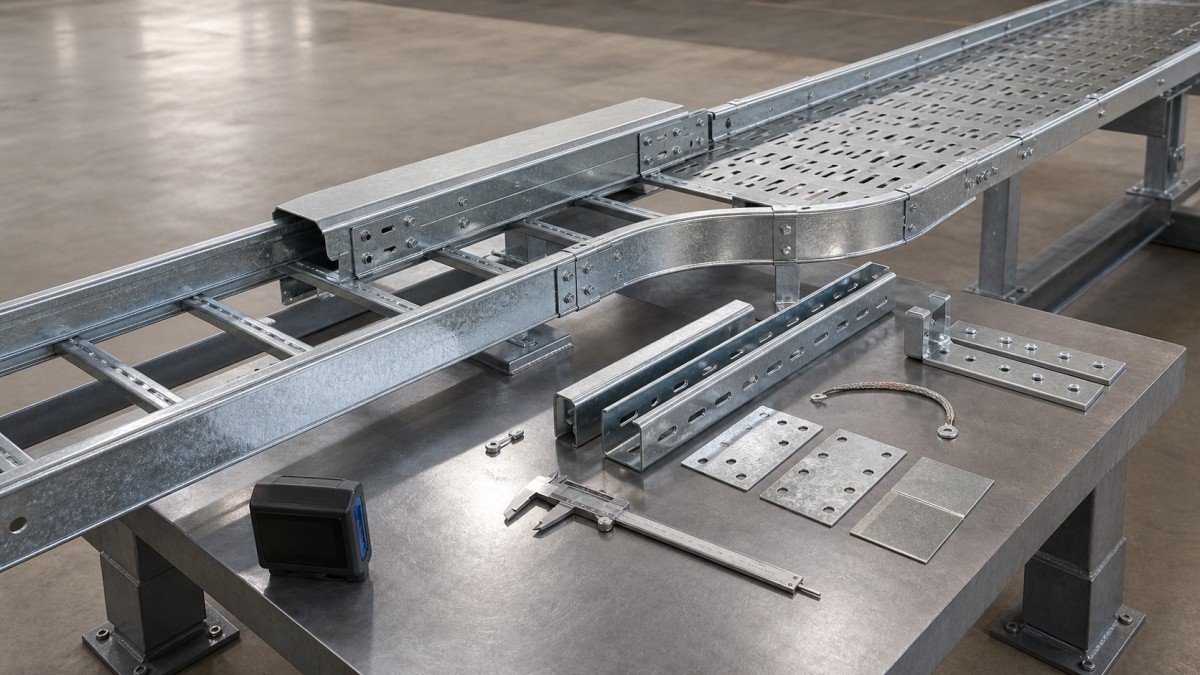
The comparison should include the complete installed package. Main straight lengths may represent most of the weight, but supports, splice plates, bends, reducers, covers, barriers, fasteners, bonding components, and site modifications also contribute to material and installation impacts.
Understand What an EPD Actually Describes
An environmental product declaration, or EPD, communicates quantified environmental information using defined programme and life-cycle assessment rules. It does not by itself certify that one product is environmentally preferable to another. Project buyers should read the scope and underlying basis before transferring an EPD value into a bid comparison.
Check whether the document is product-specific, facility-specific, manufacturer-specific, or based on an industry average. Record the programme operator, publication and expiry dates, verification status, product description, declared or functional unit, product category rules, and life-cycle modules included. Two values cannot be compared responsibly if their units, system boundaries, product definitions, or data periods are different.
The declared product range also matters. An EPD for generic steel sheet may provide useful upstream context, but it is not the same as a declaration for a fabricated cable tray system. Likewise, a declaration for one material or manufacturing site may not represent every tray type, finish, or factory in a supplier's quotation.
Request Traceable Material Information
Where the project has embodied-carbon reporting requirements, the RFQ should state the required evidence instead of asking suppliers to provide green credentials. Useful records may include material grade, source, mill certificates, mass by product group, recycled-content methodology where requested, coating specification, and manufacturing location.
Buyers should distinguish measured, calculated, and self-declared information. A recycled-content percentage, renewable electricity statement, or low-carbon steel claim should identify its method, boundary, applicable products, and supporting document. Mass-balance or certificate-based approaches should be described as such rather than presented as direct physical content unless the programme rules support that interpretation.
Traceability should remain practical. Requesting a different evidence package for every minor fastener can create paperwork without improving the decision. The project team should identify which product groups are material to its reporting objective and define the required level of detail before tender.
Do Not Trade Away Durability
Reducing initial material use can be counterproductive if the selected system corrodes early, deforms under load, or requires widespread replacement. Service environment and maintenance access should therefore remain part of the carbon review.
For dry interiors, pre-galvanized steel may be a suitable option when allowed by the specification. Outdoor or industrial exposure may require hot-dip galvanizing after fabrication, stainless steel, aluminum, or another approved finish. The correct choice depends on humidity, salt, chemicals, washdown, temperature, abrasion, cut-edge treatment, fastener compatibility, and intended service conditions.
Coating mass or thickness should not be reduced only to improve a material calculation. The project should compare options that deliver the required corrosion protection. A longer-lasting, maintainable system can be more credible than a lower initial figure that ignores replacement and access costs.
Use Design Coordination to Avoid Excess Material
Some of the most practical reductions come from better information rather than a new material label. Coordinated cable schedules can prevent oversized tray widths and duplicate routes. Verified support spacing can avoid unnecessary brackets while still meeting load and deflection requirements. Standardized fitting angles and widths can reduce one-off fabrication and site cutting.
Tray fill should be based on actual cable data, segregation rules, future capacity requirements, and installation access. Removing all spare capacity is not sound optimisation; nor is applying the same generous allowance to every route. The design team should decide where future expansion is genuinely expected.
Modular delivery planning can also reduce site waste. Clearly tagged route packages, coordinated cut lengths where feasible, approved fitting schedules, and a controlled spare-parts list help installers use the supplied material as intended. These measures should be agreed before production so that optimisation does not create fragmented orders or delays.
Include Transport, Packing, and Site Waste
Cable tray is bulky, and poor packing can increase shipment volume or damage finishes. Buyers can ask suppliers to explain nesting arrangements, bundle dimensions, protective separators, pallet or frame use, package weights, and container loading plans. The packing method must still protect tray edges, coatings, fittings, and labels through export handling.
Delivery sequence should follow site priorities where possible. Route-based bundles can reduce rehandling and misplaced components, but the labels and packing list must remain readable and consistent with the bill of quantities. Returnable packing may be useful on some supply chains, while recyclable or reduced packaging may be more practical on export projects. The RFQ should avoid prescribing a solution that cannot realistically be recovered at the destination.
Site waste reporting should separate damaged material, design changes, offcuts, surplus, and packaging. That information helps the contractor identify whether the next improvement belongs in design, fabrication, logistics, storage, or installation.
Low-Carbon Cable Tray RFQ Checklist
- Approved tray type, dimensions, profile, support span, cable load, and corrosion environment
- Complete quantity schedule for straight lengths, fittings, covers, supports, fasteners, and bonding parts
- Required EPD type, programme operator, verification, validity, declared unit, and life-cycle modules
- Material grade, product mass, mill records, manufacturing location, and coating information
- Method and evidence required for recycled content, low-carbon material, or energy claims
- Rules for comparing technically equivalent alternatives and documenting design substitutions
- Packing, bundle dimensions, shipment planning, route tags, and delivery sequence
- Required carbon-data template, document revision process, and submission deadline
Work With Hongfeng Electric
Low-carbon cable tray procurement works best when environmental information is tied to an approved technical and commercial scope. Hongfeng Electric can prepare quotations for cable tray, cable ladder, cable trunking, wire mesh tray, strut channel, supports, fittings, covers, and bonding accessories against a defined route schedule. Share the specification, BOQ, load and span requirements, exposure conditions, documentation template, and packing plan to receive a comparable project quotation and supporting product information.
Navigation
Send Us A Message
Get in touch with us
Phone