
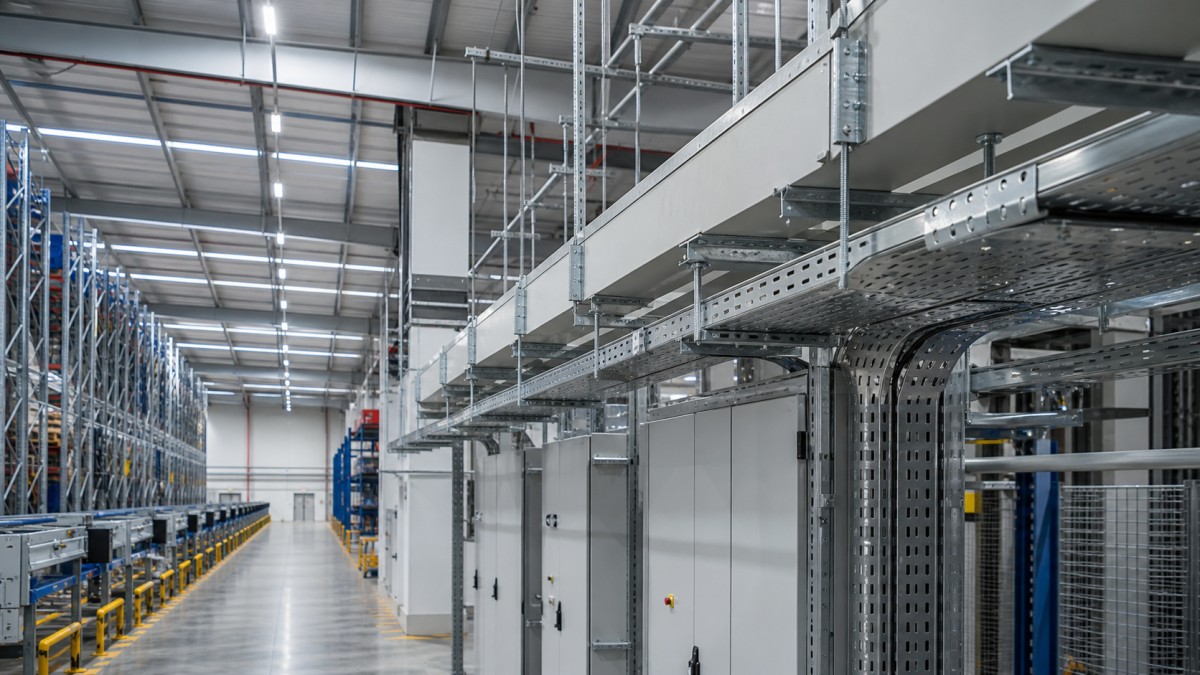
Galvanized cable tray and cable trunking installed in a clean logistics warehouse automation corridor
Logistics warehouses are no longer simple storage buildings. Many projects now combine high-bay racking, conveyors, sortation lines, automated storage and retrieval systems, charging areas, fire alarm networks, access control, CCTV, Wi-Fi, building management systems, and dense power distribution. For electrical contractors and project buyers, this makes cable tray and cable trunking planning a practical procurement issue, not only an installation detail.
A warehouse cable management package should be easy to install, clear to maintain, and flexible enough for future automation changes. If tray width, support spacing, fittings, covers, and finish are left vague in the RFQ, site teams often discover conflicts only after racks, ducts, conveyors, and sprinkler routes are already in place.
Why Warehouse Cable Routes Need Early Coordination
Warehouse electrical routes usually compete with sprinkler mains, HVAC ducts, lighting rows, conveyor steelwork, mezzanine structures, dock equipment, and racking clearances. A cable tray route that looks simple on a single-line drawing may become difficult when it reaches a sorter, a lift, a cross-aisle, or an automation control panel.
Buyers should ask for route-based cable tray planning before the purchase order is released. Main power routes, low-voltage routes, fire alarm circuits, control wiring, and data cabling may not need the same tray type or the same level of protection. Separating these routes early helps avoid overcrowding and makes later maintenance easier.
Selecting Tray Types for Warehouse Areas
Most logistics warehouse projects use a mix of cable ladder, perforated cable tray, wire mesh cable tray, and cable trunking. The right choice depends on cable weight, cable type, access requirements, dust exposure, and whether the route is likely to change after commissioning.
- Ladder cable tray: Suitable for main feeder routes, long overhead runs, and heavier power cables where ventilation and pulling access are important.
- Perforated cable tray: Useful for branch power routes, automation panels, lighting distribution, and routes where smaller cables need continuous support.
- Wire mesh cable tray: Often practical for low-voltage, data, CCTV, access control, and warehouse automation signal routes that may be modified later.
- Cable trunking: A good option where cables need more physical protection, cleaner separation, or a tidy route through office areas, control rooms, or exposed renovation zones.
The specification should also identify transition points. A project may use ladder tray for the main electrical corridor, perforated tray near automation panels, wire mesh tray along conveyor controls, and trunking through office or mezzanine areas. These transitions need reducers, bends, tees, splice plates, drop-outs, and compatible covers.
Material and Surface Finish Decisions
Many warehouses are indoor dry environments, but the finish should still match the actual area. Pre-galvanized or galvanized steel cable tray may be acceptable for protected indoor routes. Hot-dip galvanized cable tray is often preferred for loading dock areas, semi-outdoor utility zones, rooftop transitions, or locations exposed to moisture. Stainless steel is usually reserved for special environments such as cold chain facilities, washdown rooms, food logistics, coastal warehouses, or chemical storage support areas.
Powder-coated cable trunking can help with route identification or architectural requirements, but coating damage and repair methods should be discussed if the trunking will pass through active logistics areas. For any finish, straight sections and accessories should match. A galvanized tray route with ordinary unprotected fasteners is not a complete corrosion strategy.
Support Spacing and Installation Access
Warehouse roofs and structural grids can create long spans. Tray support spacing should be reviewed against tray type, cable load, and the building structure. Trapeze supports, threaded rods, cantilever brackets, wall brackets, strut channels, and hold-down clamps should be selected as part of the package, not added as a late site purchase.
Installation access also matters. Routes above conveyors or sorting equipment can become difficult to reach after machinery is installed. If maintenance access is limited, the project may benefit from more direct routes, planned inspection points, wider tray margins, or covers only where protection is actually needed. Overusing covers can slow inspection and trap dust; underusing them can expose cables in dock or service areas.
Accessories That Should Be Listed in the RFQ
A warehouse cable tray order should include more than straight tray lengths. Missing fittings are one of the easiest ways to delay a logistics project, especially when automation vendors and electrical installers work on the same schedule.
- Horizontal bends, vertical bends, tees, crosses, reducers, and end plates by tray width and side height.
- Splice plates, bolts, nuts, washers, hold-down clamps, and connector sets with matching finish.
- Trapeze supports, wall brackets, cantilever arms, strut channel, threaded rods, and anchors where required.
- Covers for dock areas, falling-object risk zones, outdoor transitions, or routes near active handling equipment.
- Drop-outs, edge protection, cable separators, and barriers for power, control, fire alarm, and data routes.
- Grounding or bonding accessories when required by the project specification and local electrical code.
Procurement Checks for AS/RS and Conveyor Zones
Automated storage and retrieval systems, sortation machines, and conveyor lines often require frequent controls changes during commissioning. For these zones, buyers should ask whether the cable tray system can support additional control cables, sensor lines, and equipment branches without heavy rework.
Wire mesh cable tray can be useful for lightweight controls, while perforated tray or trunking may be better near control cabinets where a cleaner protected route is needed. Heavy power feeders should be separated from sensitive low-voltage routes according to the project design. If the project requires fire alarm, security, or data cabling separation, make that requirement visible in the RFQ.
RFQ Checklist
- Warehouse type, building height, rack layout, conveyor or AS/RS areas, and installation environment.
- Tray type, width, side height, length, load requirement, and planned cable fill for each route.
- Material and finish, including indoor, dock, rooftop, cold storage, or coastal exposure zones.
- Support method, support spacing, mounting surface, and any structural restrictions.
- Fittings, covers, separators, splice plates, grounding accessories, fasteners, and packing by route.
- Drawings, route sketches, bill of materials, delivery schedule, and any OEM or custom size requirements.
Work With CableTrayPro
CableTrayPro can support logistics warehouse and AS/RS projects with cable tray selection, material and finish recommendations, custom sizes, OEM/ODM supply, support accessories, and fast quotation based on drawings or a route list. Send your project layout, tray schedule, or preliminary RFQ, and our team can help prepare a practical cable management package for bulk project supply.
Navigation
Send Us A Message
Get in touch with us
Phone