
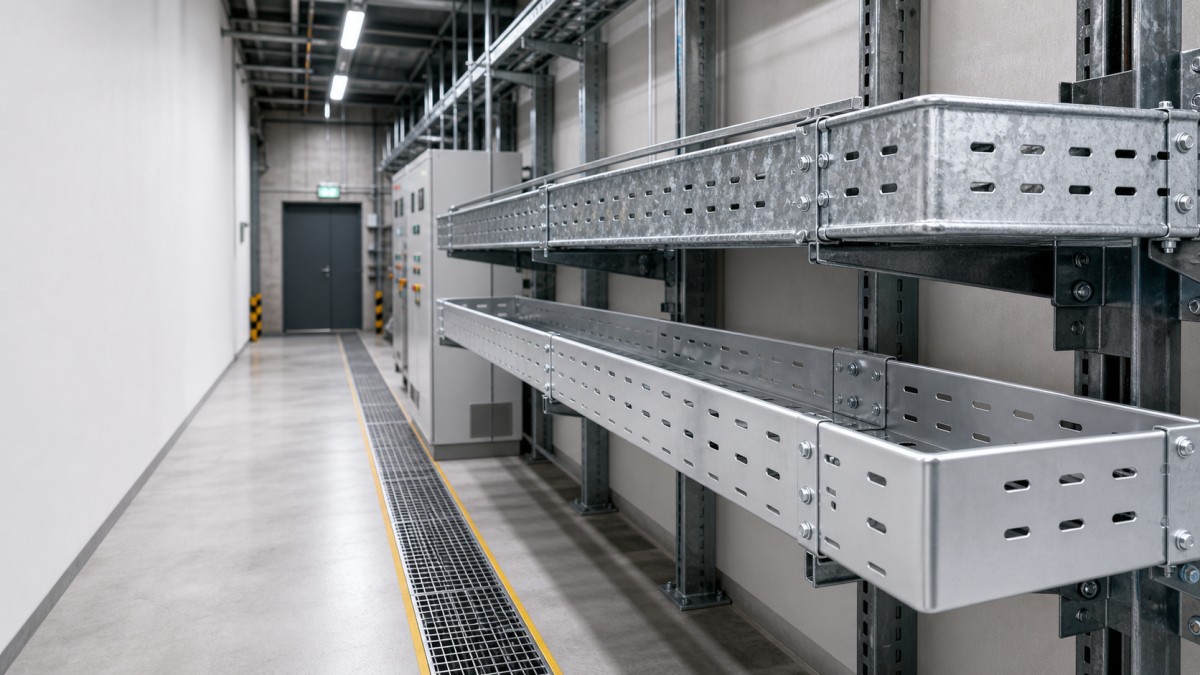
Galvanized cable tray is widely used in industrial plants, commercial buildings, infrastructure projects, renewable energy sites, and utility corridors. However, buyers often use the word “galvanized” too broadly. Hot-dip galvanized cable tray and pre-galvanized cable tray are not the same product, and the difference can affect corrosion resistance, service life, site repair work, and total project cost.
For procurement teams, the question is not simply which tray has the lower unit price. The correct choice depends on where the tray will be installed, how the tray is fabricated, whether cut edges are exposed, what fittings and supports are supplied, and how the owner expects the system to perform over time. This guide explains the practical differences for B2B buyers, contractors, and project engineers.
What Pre-Galvanized Cable Tray Means
Pre-galvanized cable tray is made from steel sheet or coil that has already received a zinc coating before the tray is fabricated. The steel is then cut, punched, bent, and formed into tray sections. This process can be efficient and economical for indoor or protected areas where the corrosion risk is moderate.
The key issue is that fabrication happens after the steel has been galvanized. Cut edges, punched holes, and formed areas may have less protection than the flat sheet surface. In dry indoor installations, this may be acceptable under the project specification. In outdoor, humid, coastal, or chemical environments, these exposed areas can become weak points.
Pre-galvanized tray is often selected for electrical rooms, indoor production areas, commercial building corridors, and other controlled environments. It should not automatically be used for outdoor routes just because it is described as galvanized steel.
What Hot-Dip Galvanized Cable Tray Means
Hot-dip galvanized cable tray is typically galvanized after fabrication. The tray is formed first, then dipped in molten zinc according to the specified galvanizing process. This helps cover the tray body, edges, punched areas, and many fabricated surfaces with a zinc layer after the final shape has been made.
For outdoor cable tray routes, hot-dip galvanizing is often preferred because it provides more complete corrosion protection than a tray fabricated from pre-coated sheet. It is commonly used for outdoor industrial corridors, utility routes, solar and battery storage projects, water treatment plants, ports, chemical plants, and infrastructure projects.
Hot-dip galvanized cable tray can cost more than pre-galvanized tray, but the price difference should be evaluated against project exposure, maintenance cost, and the risk of premature corrosion. For harsh or outdoor sites, using a lower-cost finish can be expensive if the system later needs replacement or repair.
Practical Comparison for Buyers
Where Hot-Dip Galvanized Tray Is Usually the Safer Choice
Hot-dip galvanized tray is often selected when the cable route is exposed to rain, humidity, outdoor dust, coastal air, industrial pollution, or long service life requirements. Typical applications include rooftop utility routes, solar PV installations, battery energy storage systems, water treatment plants, outdoor pipe racks, transport infrastructure, and chemical plant service corridors.
It is also useful where the tray has many punched areas or fabricated fittings. Bends, tees, reducers, splice plates, and supports should be supplied with compatible finish so that the complete system has consistent corrosion performance. Buying hot-dip galvanized straight sections but using mismatched pre-galvanized or painted accessories can create weak points.
Where Pre-Galvanized Tray Can Be Suitable
Pre-galvanized cable tray can be a cost-effective choice for indoor electrical rooms, dry commercial buildings, protected factory interiors, and light-duty routes with limited exposure. It is often easier to justify where the environment is controlled and the project owner accepts the finish for the intended location.
Buyers should still check the route carefully. A tray that begins in an indoor room may pass through an exterior wall, canopy, rooftop, or wet service area. If only a small section is exposed, the project may need a different finish for that section or a transition to hot-dip galvanized or stainless steel tray.
Questions to Ask Before Ordering
- Will the cable tray be installed indoors, outdoors, under a canopy, in a humid room, or near chemicals?
- Does the specification require hot-dip galvanizing after fabrication?
- Are fittings, covers, brackets, splice plates, and fasteners supplied with compatible finish?
- How will cut edges, drilled holes, or damaged coating be repaired on site?
- Is the tray route exposed to coastal air, road salt, process chemicals, or washdown activity?
- Does the owner prioritize lowest initial price or longer service life with lower maintenance risk?
Procurement Advice for Overseas Buyers
When requesting a quotation, avoid using only the phrase “galvanized cable tray.” Specify whether you need pre-galvanized steel cable tray or hot-dip galvanized cable tray. Include tray width, side height, thickness, length, load requirement, fittings, cover requirement, support span, and surface finish. If the project has an owner specification, share the relevant finish requirement with the supplier.
For export projects, packaging also matters. Hot-dip galvanized tray can be damaged by rough handling if it is not packed properly. Ask for protective packing, clear labels, and accessory lists by route or area. This helps the contractor install the system without mixing finishes or losing small parts.
Buyers should also ask how the supplier will identify the finish on documents and packing lists. If a project uses both hot-dip galvanized tray and pre-galvanized tray in different areas, similar-looking bundles can be mixed on site. Clear product labels, route numbers, and separate accessory boxes help installers use the correct fittings in the correct environment.
Inspection before shipment is another practical step. Check whether the tray dimensions, side height, hole pattern, fitting type, and surface finish match the purchase order. For large projects, reviewing photos or inspection reports before loading can prevent expensive disputes after the shipment arrives.
Final Buying Advice
Hot-dip galvanized and pre-galvanized cable trays both have useful applications, but they should not be treated as interchangeable. Pre-galvanized tray is usually best for dry, protected areas. Hot-dip galvanized tray is generally the safer choice for outdoor and more demanding environments. The correct decision should be based on exposure, fabrication details, accessories, and maintenance expectations.
HONGFENG / Cable Tray Pro supplies hot-dip galvanized cable tray, pre-galvanized cable tray, ladder tray, perforated tray, cable trunking, covers, brackets, and related accessories. Send us your project environment, tray size, route layout, and finish requirement, and our team can help prepare a practical quotation.
Navigation
Send Us A Message
Get in touch with us
Phone