
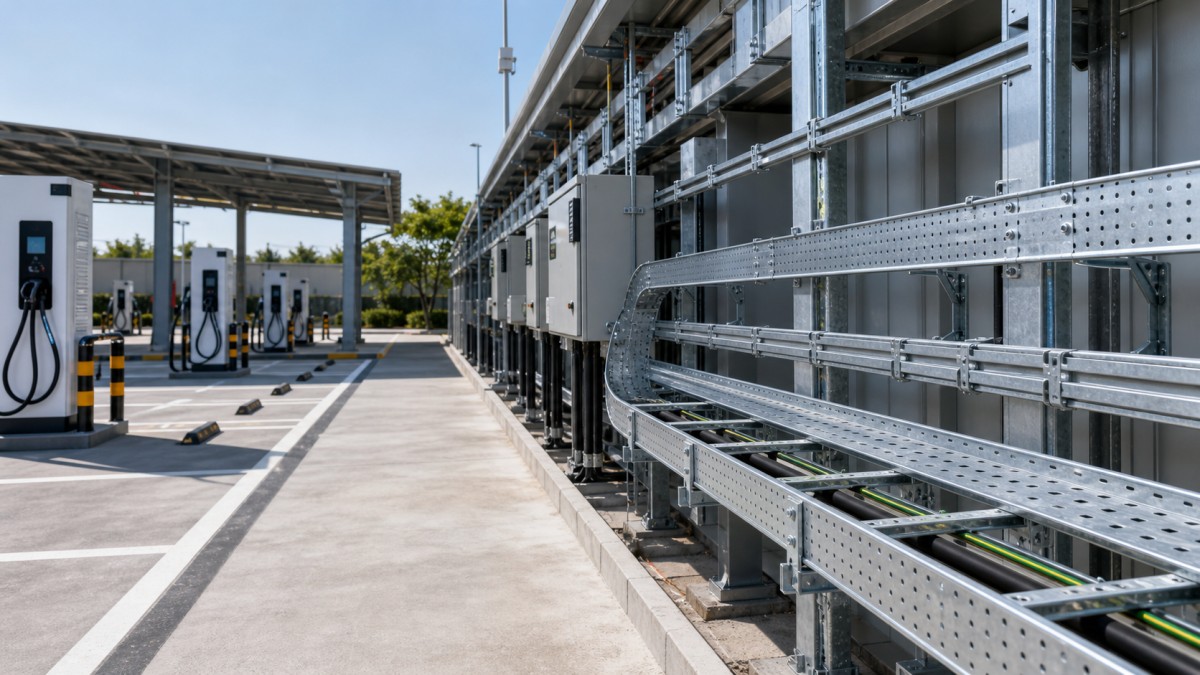
EV charging depots and parking structures are becoming more demanding electrical environments. A small commercial charger installation may only need a short conduit run, but a fleet depot, bus charging yard, logistics hub, or multi-level parking garage can include long feeder routes, power distribution equipment, communication lines, load management controls, and repeated charger positions. Cable tray planning affects installation speed, maintenance access, future expansion, and the total cost of the electrical package.
For buyers, the tray itself is only one part of the decision. The project also needs suitable fittings, support brackets, covers, splice plates, hold-down clamps, grounding coordination, and a surface finish that matches the site environment. If these details are not clarified before purchase, the contractor may need field modifications, extra cutting, or urgent accessory orders during installation.
Why EV Charging Sites Need Planned Cable Routes
EV charging projects often combine heavy power cables with smaller control and communication cables. The route may begin at a transformer or switchboard, pass through an outdoor equipment area, enter a canopy or parking garage, and then branch to charger pedestals or wall-mounted chargers. Compared with a simple indoor electrical room, the route usually has more turns, more equipment interfaces, and a stronger need for future charger expansion.
A clear cable tray layout helps the engineering team coordinate cable bend radius, separation of circuits, support locations, charger spacing, drainage, vehicle clearance, and access for maintenance. It also helps procurement teams order a complete cable tray system instead of only straight tray lengths.
For fleet charging yards, tray routes may need to cross open outdoor areas or run along steel structures. For parking garages, routes may need to follow beams, avoid sprinkler systems and ventilation ducts, and keep headroom clear. In both cases, early coordination between the electrical, structural, fire safety, and civil teams is important.
Selecting the Right Tray Type for EV Charging Routes
The best cable tray type depends on cable size, route exposure, available space, and maintenance requirements. Many EV charging projects use more than one tray type across the same site.
Ladder Cable Tray
Ladder cable tray is often selected for main feeder routes where larger power cables need mechanical support and ventilation. The open rung structure supports cable pulling, heat dissipation, and inspection. It is useful for long outdoor or semi-outdoor runs when the tray load rating, rung spacing, and support span are properly specified.
Perforated Cable Tray
Perforated cable tray provides a continuous bottom surface with ventilation and drainage openings. It can be suitable for smaller feeder cables, branch circuits, auxiliary power, and mixed electrical routes where more cable support is needed than a ladder tray provides. In parking garages and service corridors, perforated trays also provide a cleaner visual line.
Cable Trunking or Trough Cable Tray
Cable trunking and trough-style cable tray provide more enclosure for control wiring, communication cables, and building-side routes. They can help protect cables from dust, accidental contact, and local activity. For outdoor EV charging routes, designers should confirm drainage, condensation control, and cover details before using a fully enclosed route.
Material and Surface Finish for EV Charging Environments
EV charging sites can expose cable trays to rain, dust, road salt, humidity, cleaning chemicals, vehicle exhaust, and strong sunlight. The surface finish should be chosen according to the actual installation environment, not only by the lowest unit price.
For outdoor fleet depots, hot-dip galvanized cable tray is often a practical starting point because it balances strength, corrosion protection, and cost. However, buyers should confirm the actual galvanizing method and not assume every galvanized tray has the same protection. In coastal or aggressive environments, stainless steel or another corrosion-resistant specification may be more appropriate.
Support Design, Expansion, and Maintenance Access
Cable tray support design is critical for EV charging projects because long routes may carry heavy feeders and may also need to remain accessible after the site is in operation. Support spacing should match the tray type, load rating, cable weight, and project specification. A tray that is strong enough in the catalog can still perform poorly if supports are too far apart or if brackets are not suitable for the structure.
Outdoor routes should also consider thermal movement, drainage, and cable entry points. In parking structures, the tray must avoid conflicts with beams, pipes, lighting, signs, ventilation equipment, and fire protection systems. In depots, routes should be protected from vehicle impact and should not block normal maintenance paths around chargers, switchgear, or energy storage equipment.
Future expansion is another important issue. Many fleet operators begin with partial charger deployment and add more chargers later. If the initial tray system has no spare capacity or no logical branching points, later expansion can become more expensive than necessary.
Accessories That Prevent Field Problems
A complete EV charging cable tray order should include the accessories needed to build the route as designed. Missing accessories are one of the common reasons for site delays.
- Horizontal bends, vertical bends, tees, crosses, reducers, and end plates for routing changes.
- Couplers, splice plates, bolts, nuts, washers, and grounding bonding jumpers where required by the project.
- Tray covers for locations exposed to sunlight, falling debris, or accidental contact.
- Wall brackets, trapeze supports, cantilever arms, hold-down clamps, and channel supports.
- Barriers or separate routes where power, control, and communication cables require separation.
- Touch-up materials or repair methods for cut edges and damaged coating areas.
Procurement teams should ask suppliers to quote the system by layout or bill of materials, not only by tray length. This reduces the risk of receiving straight sections without the fittings and supports needed for installation.
Procurement Checklist for EV Charging Cable Tray Buyers
- Confirm the route location: indoor, outdoor, canopy, parking garage, rooftop, or open yard.
- Identify tray type by route section: ladder tray, perforated tray, trunking, or trough tray.
- Confirm material and finish, including corrosion exposure, fasteners, and compatible accessories.
- Check tray width, side height, load rating, support span, and cable fill allowance.
- Review bend radius, cable pulling access, cover requirements, and drainage.
- Include fittings, splice plates, brackets, clamps, covers, and grounding-related components.
- Confirm packaging, labeling, drawings, delivery schedule, and spare accessories for site adjustment.
Final Buying Advice
EV charging projects need cable tray systems that can support heavy power distribution, repeated charger connections, and long-term site maintenance. The most reliable purchasing approach is to specify the tray system by route, environment, cable load, and accessory requirement. A lower tray price is not helpful if the project later requires missing fittings, field drilling, coating repair, or route redesign.
HONGFENG / Cable Tray Pro can support EV charging depot and parking structure projects with ladder cable tray, perforated cable tray, cable trunking, hot-dip galvanized tray, stainless steel tray, covers, brackets, and related accessories. Send us your layout, environment, tray size, and finish requirement, and our team can help prepare a practical cable tray quotation for your project.