
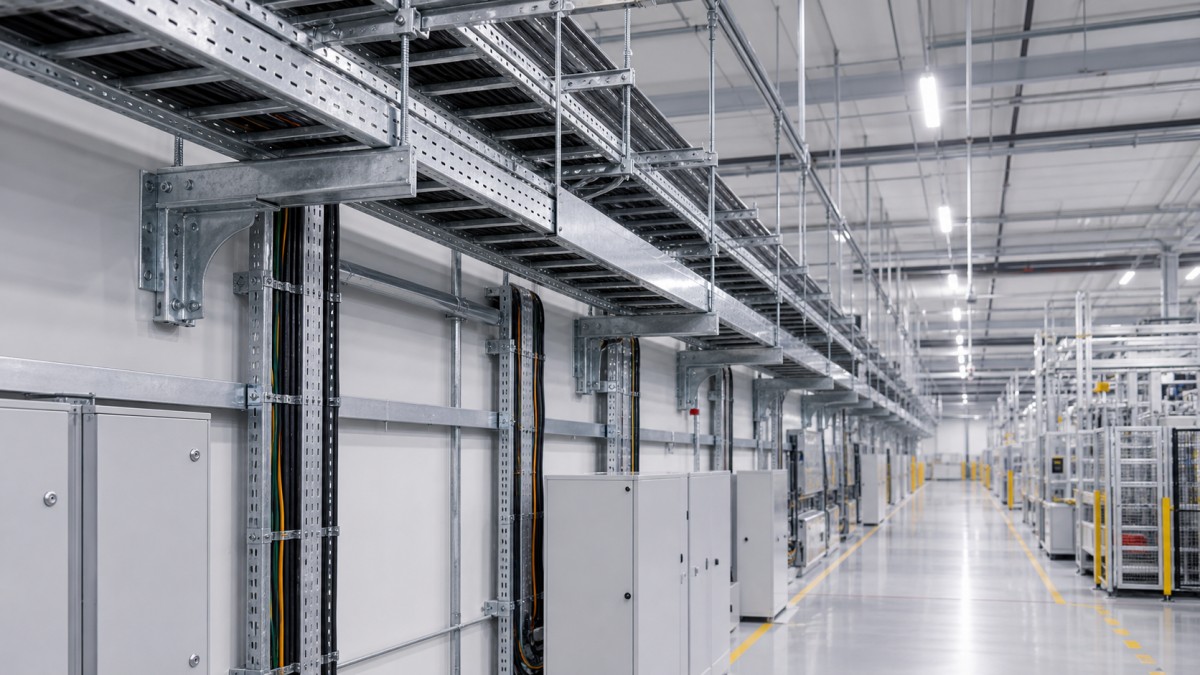
Battery manufacturing plants are dense electrical environments. A single facility may include raw material preparation, coating, drying, calendaring, slitting, cell assembly, formation, testing, module assembly, pack assembly, warehouses, utilities, fire protection systems, and building automation. Each area has different cable routing needs, and the cable tray system must be planned before equipment installation blocks access.
For EPC contractors and overseas buyers, the cable tray package should be treated as part of the factory infrastructure, not as a commodity list of straight tray lengths. Power cables, control cables, data cables, instrumentation cables, and safety systems all need routes that are organized, accessible, and compatible with the production environment. A clear specification reduces installation conflicts and helps the supplier prepare a complete package.
Why Battery Plants Need Careful Cable Tray Planning
Battery plants often combine high equipment density with strict environmental control. Some areas may require dry-room coordination, while others include humid utility rooms, process exhaust zones, cooling systems, compressed air, nitrogen, fire protection equipment, and material handling systems. Cable tray routes must fit around ducts, pipes, structural steel, conveyors, equipment frames, and maintenance paths.
Production lines may also change over time. New equipment, additional testing capacity, automation upgrades, or layout changes can require future cable additions. Cable tray gives engineers more flexibility than fully enclosed conduit routes, but only if the original design leaves enough space and uses accessible support locations.
For buyers, a good cable tray plan should answer three questions: what type of tray is required for each route, what surface finish matches the environment, and what accessories are needed to install the system without delays.
Tray Types for Battery Manufacturing Areas
Ladder Cable Tray
Ladder cable tray is commonly used for main power distribution, feeder routes, utility corridors, plant rooms, and long overhead runs. It offers strong mechanical support and good ventilation around larger cables. In battery plants, ladder tray is often the first option to evaluate for routes between substations, power distribution cabinets, motor control centers, and large equipment areas.
Perforated Cable Tray
Perforated cable tray provides more continuous support for smaller power, control, instrumentation, and automation cables. It can be used in production areas, technical floors, utility corridors, and building services routes. Covers may be required where cables need protection from dust, falling objects, or nearby process activity.
Cable Trunking
Cable trunking is useful for control rooms, equipment-side wiring, low-voltage circuits, and areas where a cleaner enclosed route is preferred. Buyers should confirm access cover design, cable exit points, bend radius, and available space for future circuits.
Wire Mesh Cable Tray
Wire mesh cable tray can be selected for data, communication, sensors, and low-voltage automation networks. It is lightweight and easy to adapt, but it should still be checked for load, support spacing, cable protection, and separation from power circuits.
Material and Finish by Factory Environment
Battery manufacturing facilities may include clean production areas, dry rooms, general utility corridors, outdoor equipment yards, chemical-adjacent rooms, and warehouses. The same tray finish may not be appropriate for every route. Buyers should ask the project engineer to define the environment route by route.
Hot-dip galvanized cable tray is often practical for utility and outdoor routes. Stainless steel may be preferred in more demanding environments, especially where humidity, cleaning process, or chemical exposure is a concern. The tray, fittings, supports, and fasteners should be reviewed as one system, not as separate items from unrelated suppliers.
Routing and Separation Issues Buyers Should Clarify
Battery plants include many electrical and control systems. Power cables, communication cables, fire alarm circuits, building automation, machine control, security, and process instrumentation may not all belong in the same tray. The project specification should define separation requirements and route ownership before materials are ordered.
- Confirm which routes are for power, control, data, instrumentation, fire alarm, or safety systems.
- Define whether barriers, separate trays, or spacing are required between different cable groups.
- Coordinate tray elevation with ducts, process piping, sprinklers, cable pulling access, and equipment service zones.
- Reserve space for future production line changes and equipment upgrades.
- Check whether tray covers are required in dusty, public-adjacent, or process-adjacent areas.
- Confirm bend radius and cable pulling direction for larger power cables before finalizing fittings.
Many installation problems are caused by incomplete accessory lists. Bends, tees, crosses, reducers, drop-outs, covers, dividers, splice plates, hold-down clamps, end caps, and fasteners should be listed with the same care as straight tray sections.
Another point is installation sequencing. Tray routes above production equipment should be installed early enough to avoid working over sensitive machinery later, but late enough that final equipment interfaces are clear. Buyers can reduce risk by confirming route drawings, support details, and accessory quantities before equipment delivery begins.
RFQ Checklist for Battery Plant Projects
A strong RFQ allows suppliers to quote more accurately and helps the procurement team compare offers fairly. Battery plant buyers should include both technical and logistics information.
- Route schedule by area: production hall, utility corridor, dry room, plant room, warehouse, or outdoor yard.
- Tray dimensions: width, side height, thickness, standard length, and load requirement if available.
- Material and finish: pre-galvanized, hot-dip galvanized, stainless steel, powder-coated, or project-specific requirement.
- Accessory schedule: bends, tees, crosses, reducers, covers, dividers, drop-outs, and end plates.
- Support system: brackets, strut channel, threaded rods, clamps, anchors, and fasteners.
- Packing method: route labels, phase labels, accessory bundling, and spare hardware allowance.
- Documentation: drawings, packing list, finish description, and installation notes required by the contractor.
Final Buying Advice
Battery manufacturing and EV supply chain plants need cable tray systems that support dense production equipment while remaining accessible for inspection and future changes. Buyers should avoid placing purchase orders based only on weight or straight tray quantity. The right package includes tray bodies, fittings, covers, supports, fasteners, route labels, and practical packing.
HONGFENG / Cable Tray Pro can support battery manufacturing projects with ladder cable tray, perforated cable tray, cable trunking, wire mesh cable tray, hot-dip galvanized cable tray, stainless steel cable tray, and matched accessories. Send your layout drawings, route schedule, environmental requirements, and quantity list to prepare a cable tray quotation that fits the installation plan.