
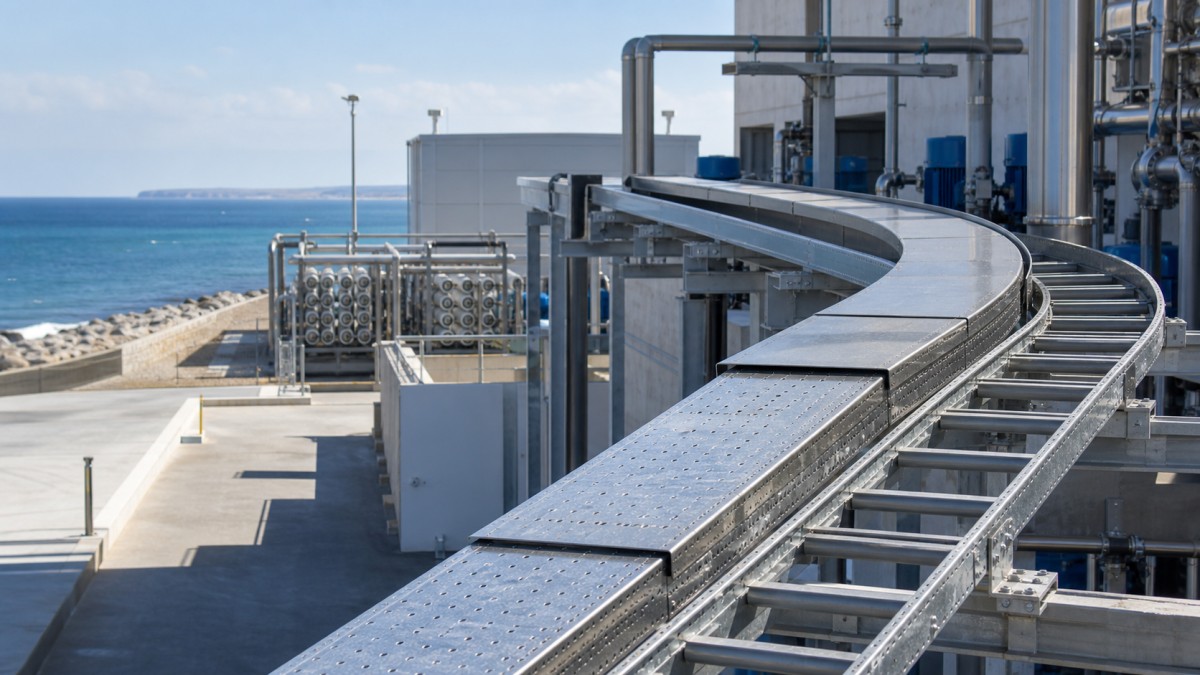
Automotive assembly and electric vehicle plants are built around production flow. Body shops, paint shops, battery or powertrain areas, final assembly, testing, utilities, warehouses, and maintenance workshops may all require different cable management approaches. Production equipment is also subject to change, so cable tray must support today's route while leaving a practical path for future machines, controls, and line modifications.
For EPC contractors and plant procurement teams, the main challenge is not selecting one tray type. It is coordinating tray geometry with production equipment, overhead services, robotics, access platforms, safety zones, and the cable groups serving each line. A clear system schedule reduces field cutting and makes later expansion easier to control.
Start with Production Zones and Cable Functions
The route should be divided by process zone and cable function. Main power feeders, robot power, controls, safety circuits, communication, lighting, and building services may need separate paths or clear segregation. The appropriate arrangement depends on the plant design and project requirements, but the cable tray system must provide enough width, support, and access for the chosen separation method.
Paint shops and washdown areas may require more attention to enclosure, cleaning, humidity, and finish. Body and assembly areas may prioritize overhead clearance, impact protection, and frequent equipment changes. Utility areas may carry larger feeder cables and require heavier tray and support systems. Treating these zones separately makes the RFQ more accurate.
- Body shop and welding areas: review power, controls, robot interfaces, and mechanical protection.
- Paint shop and pretreatment: review humidity, cleaning, enclosure, and route access requirements.
- Battery or powertrain areas: coordinate larger feeders, control circuits, safety systems, and future production changes.
- Final assembly: provide flexible branches to stations without blocking operators, conveyors, or maintenance paths.
- Utilities and compressor rooms: check cable load, heat, vibration, and support attachment points.
Select Tray Type for the Route, Not the Plant Name
Ladder Cable Tray for Main Production Feeders
Ladder cable tray is commonly reviewed for main feeder routes and larger production equipment because it provides regular support, ventilation, and access for cable pulling. It can be useful on overhead steelwork or along utility corridors, provided the support span and cable loading are checked. The route should leave enough clearance around bends and terminations so cables are not forced into an unsuitable radius.
Perforated Tray for Controls and Instrumentation
Perforated cable tray offers continuous bottom support and convenient fixing points for control, sensor, lighting, and auxiliary cables. It is often useful where many small branches leave the main route. Buyers should confirm the hole pattern, side-rail height, divider options, and branch fittings, especially where the installation team must add cables after equipment commissioning.
Trunking for Protected Branches and Clean Routes
Enclosed cable trunking or trough-style tray can protect smaller cable groups from dust, accidental contact, or nearby activity. It can also provide a cleaner route beside walls, production stations, or control panels. Enclosure should be balanced against heat dissipation, condensation, access, and the need to pull or replace cables. A small branch should not be enclosed so tightly that maintenance becomes difficult.
Material Finish, Covers, and Production Environment
Pre-galvanized or galvanized steel may suit many indoor production routes, but the final choice depends on humidity, cleaning, chemical exposure, and the project finish requirements. Paint shops, pretreatment areas, cooling zones, and exterior utility spaces may need different protection from a dry assembly corridor. The tray body, support steel, covers, bolts, nuts, washers, and splice plates should be reviewed together.
Covers are useful where the route is exposed to falling material, cleaning activity, or accidental contact. They can also help protect cables near equipment, but they add weight and can reduce visibility. Before specifying a cover, confirm ventilation, access, cable temperature, drainage, and whether future branches can be made without dismantling a long section.
A professional appearance matters in visible production areas, but appearance should follow function. The most useful finish is the one that matches the environment and can be supplied consistently across the tray, accessories, supports, and replacement parts.
| Automotive plant route | Suitable starting point | Procurement focus |
|---|---|---|
| Main feeder and utility route | Ladder cable tray | Load, span, cable radius, support steel, future capacity |
| Robot, sensor, and control branches | Perforated tray with dividers or branch fittings | Segregation, access, bend fittings, spare route space |
| Paint shop or washdown area | Covered or corrosion-resistant tray as specified | Humidity, cleaning, enclosure, coating, drainage |
| Wall-mounted station branch | Compact trunking or trough cable tray | Clean appearance, access, fittings, panel entries |
Support Coordination and Future Changes
Automotive plants often have congested overhead zones. Cable tray supports must be coordinated with cranes, ventilation ducts, process piping, lighting, sprinklers, access platforms, and robot envelopes. A tray route that looks clear on an electrical plan may still conflict with maintenance or production equipment when the combined model is reviewed.
Support spacing should follow the tray configuration, cable load, span, and fitting arrangement. Additional support may be needed near elbows, tees, risers, equipment entries, and locations where cables leave the tray. The quotation should make clear which supports are included and whether the supplier is providing only tray lengths or a complete support package.
Future capacity should be planned without oversizing every tray. A better method is to identify likely expansion zones, keep accessible branch points, reserve selected spare route space, and document the intended cable segregation. This supports production changes while keeping the initial installation controlled.
Installation Handover and Line Modification
A new automotive line is rarely finished when the tray is installed. Commissioning teams may add sensors, change robot positions, or adjust panel locations. The handover package should therefore include route drawings, fitting quantities, support locations, spare covers, and the approved method for field changes. Clear records help the maintenance team modify a route without cutting structural members or mixing incompatible fittings.
During inspection, confirm tray alignment, support tightness, cable separation, cover fit, bend transitions, and clearance from moving equipment. Check that cable entries do not create sharp edges and that the branch route remains accessible. These simple checks can prevent a tray system from becoming an obstruction when the production line is adjusted.
Keep a small stock of project-matched splice plates, covers, clamps, and branch fittings for planned line changes. Matching replacement parts are easier to install and reduce the risk of mixing finishes or dimensions during a production shutdown.
This also supports faster maintenance planning during scheduled shutdowns.
Automotive Cable Tray RFQ Checklist
- Separate the bill of quantities by body shop, paint shop, assembly, utilities, test, warehouse, and outdoor areas.
- List tray type, width, height, thickness, finish, cover, divider, and straight-length requirements.
- Include all elbows, tees, crosses, risers, reducers, splice plates, covers, clamps, and support structures.
- Show cable groups and the required separation method for power, controls, communication, safety, and building services.
- Coordinate tray routes with production equipment, cranes, HVAC, piping, lighting, sprinklers, and maintenance clearances.
- Request drawings, material or coating information, loading data, packing details, and a clear replacement-part strategy.
The most reliable procurement package describes the production route, the cable function, the environment, and the complete accessory system. HONGFENG / Cable Tray Pro can help automotive and EV plant teams review ladder tray, perforated tray, trunking, covers, supports, and customized fitting schedules. Share the plant layout, cable list, route quantities, and environmental zones for a practical quotation review.
Navigation
Send Us A Message
Get in touch with us
Phone