
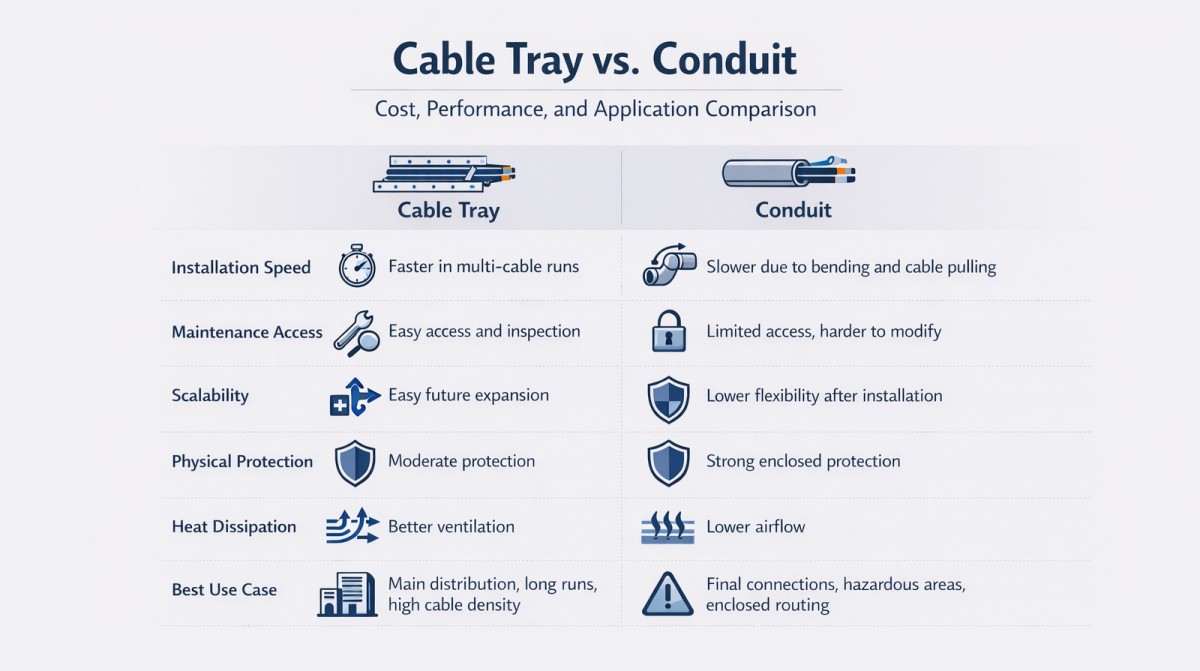
Figure 1. Practical comparison of cable tray and conduit systems for industrial and commercial projects.
Choosing between cable tray and conduit remains one of the most important decisions in electrical infrastructure design. The right choice can improve installation efficiency, simplify future maintenance, and reduce long-term project costs. The wrong one can create avoidable complexity, limit flexibility, and make future upgrades more expensive than expected.
In 2026, this comparison matters even more. Data centers, industrial plants, commercial buildings, renewable energy facilities, and infrastructure projects are all facing higher cable density, tighter construction schedules, and stronger demands for future expandability. As a result, engineers, contractors, and project managers are paying closer attention not only to initial installation cost, but also to lifecycle performance.
This guide compares cable tray and conduit from a practical project perspective, including installation, maintenance, environmental suitability, fire safety, and long-term flexibility.
Understanding the Difference
A cable tray is a structural support system designed to carry and organize cables along a defined route. Depending on the project, cable trays may be ladder type, perforated, solid-bottom, wire mesh, or channel type. Each design serves different requirements for cable load, ventilation, accessibility, and installation conditions.
A conduit is a closed tube or pipe used to enclose and protect cables. Common conduit types include rigid metal conduit (RMC), electrical metallic tubing (EMT), intermediate metal conduit (IMC), and PVC conduit.
The key difference is simple: cable trays support cables on a structure, while conduits route cables inside a structure. That difference affects almost everything else, including labor intensity, cable access, heat dissipation, protection level, and future expansion.
Why This Comparison Matters More in 2026
Modern projects are carrying more cables than ever before. Power distribution, data transmission, automation systems, EV infrastructure, and smart building systems all contribute to greater cable volume and more complex routing requirements.
In this environment, the traditional habit of choosing conduit by default is being reconsidered. Many projects now prioritize:
- Faster installation schedules
- Easier access for inspection and upgrades
- Better cable organization in high-density systems
- Lower disruption during future expansion
- More flexible infrastructure planning
That is why cable tray systems are becoming more common in large-scale industrial and commercial applications, especially where cable routes are long, dense, or expected to change over time.
Installation Cost and Labor Efficiency
In many multi-cable installations, cable tray systems offer a clear labor advantage over conduit systems.
Conduit installation is mechanically intensive. It often requires cutting, bending, threading, coupling, and pulling cables through enclosed pathways. This process can be time-consuming, especially on large projects with multiple circuits, long runs, or routing complexity.
Cable tray installation is typically more straightforward. Once the support system is installed, cables can be laid in more efficiently and accessed from multiple points along the route. For projects involving long runs or high cable volume, this often results in faster installation and lower labor demand.
Cable trays can also reduce material complexity. Instead of using multiple parallel conduit runs, one properly designed cable tray system may accommodate a larger number of cables within a single routing structure.
That said, conduit can still be the more economical choice in smaller or simpler applications. For short runs, limited circuits, or final equipment connections, conduit may provide a practical and cost-effective solution.
Quick Comparison Table
Maintenance and Lifecycle Considerations
One of the biggest advantages of cable tray systems is accessibility.
In facilities where cable systems may change over time, such as data centers, factories, commercial buildings, or infrastructure upgrades, cable trays make it easier to add, remove, inspect, or reroute cables. Maintenance teams can work more efficiently because the cable path is visible and accessible.
Conduit systems are less flexible in this respect. Any cable replacement or expansion may require pulling cables through enclosed tubes, checking fill capacity, or even adding new conduit routes. Over time, that can increase labor, downtime, and modification costs.
For projects with stable, unchanging cable requirements, this may not be a major issue. But for facilities that anticipate growth, retrofit work, or phased expansion, cable trays usually provide a better long-term outcome.
Performance in Different Environments
The best system depends heavily on the installation environment.
Cable trays are often the better choice when:
- Cable density is high
- Heat dissipation is important
- Frequent changes or future additions are expected
- Long cable runs need efficient support
- Easy visual inspection is preferred
Conduit is often preferred when:
- Cables require stronger mechanical protection
- Routing must be enclosed or concealed
- Hazardous or classified environments require sealed pathways
- Local codes or project specifications call for individual circuit protection
In practice, environmental suitability should always be checked against local regulations, site conditions, and project-specific engineering requirements.
Fire Safety Considerations
Fire safety is a critical factor in both cable tray and conduit design, but the comparison is not as simple as closed is safer and open is weaker.
Conduit naturally provides enclosed cable routing, which may be beneficial in some fire protection strategies. However, modern cable tray systems can also be designed for fire-rated applications through the use of appropriate materials, covers, barriers, coatings, and compliant cable selection.
The right solution depends on the required fire performance, circuit integrity expectations, and the standards applicable to the project. In many cases, the decision should be based on the full system design rather than on the support method alone.
For fire-sensitive applications, designers should always confirm requirements with the relevant local codes, project specifications, and testing standards.
Scalability and Future-Proofing
Scalability is one of the strongest reasons many modern projects choose cable tray systems.
A well-designed cable tray system can accommodate future cable additions more easily than conduit. If spare capacity is built into the tray design from the beginning, expansion can often be handled without major structural changes.
Conduit systems are less forgiving. Once conduit size, fill rate, and route are fixed, adding capacity usually means installing additional conduit, modifying supports, or rerouting sections of the system.
For industries experiencing rapid growth in cable demand, such as data centers, renewable energy, automation, EV charging, and smart infrastructure, this difference can be highly significant.
When to Choose Cable Tray
Cable tray is often the better option when your project involves:
- High cable volume
- Long routing distances
- Future cable additions
- Easier maintenance access
- Better ventilation requirements
- Faster installation expectations
It is especially effective in industrial plants, commercial buildings, utility facilities, data centers, and infrastructure projects where flexibility and serviceability are important.
When to Choose Conduit
Conduit is often the better choice when your project requires:
- Strong mechanical protection
- Sealed cable routing
- Short and simple circuit runs
- Concealed appearance
- Compliance with specific code or hazardous-area requirements
It is commonly used for final equipment connections, exposed-risk locations, and applications where enclosed protection is more important than accessibility.
In Many Projects, a Hybrid Approach Works Best
The decision does not always need to be one or the other.
Many well-designed facilities use cable tray for main distribution routes and conduit for final drops or equipment connections. This hybrid approach combines the efficiency and flexibility of cable tray with the protection and routing control of conduit where it matters most.
For complex industrial or commercial projects, this is often the most practical and balanced solution.
Conclusion
There is no universal answer to the cable tray versus conduit question. The right system depends on cable density, environment, protection requirements, maintenance expectations, and future expansion plans.
However, in many industrial and commercial projects in 2026, cable tray systems offer a strong advantage in installation efficiency, accessibility, and long-term flexibility. Conduit remains essential in applications where enclosed protection, code requirements, or mechanical resistance are the top priorities.
The best choice is the one that matches the real conditions of your project, not just past habits or standard assumptions.
If your project involves long cable runs, high cable density, or future expansion, a tray-based design may offer a more efficient and scalable solution over the full lifecycle of the system.
Need help selecting the right cable tray system for your project? Contact our team for technical support and a custom quotation.
Navigation
Send Us A Message
Get in touch with us
Phone